Smarighad
The Ballad of the Last DragonSmarighad is Sylvaine Abelan’s lost homeland and the emotional landscape against which her later life is measured. In memory it is a place of towering trees, enormous oyster mushrooms, ancestral claims, and childhood movement; in history it becomes a territory emptied by elven raids, restrictive laws, and fear. Sylvaine’s departure from Smarighad saves her from immediate danger but costs her family, home, and the security of belonging, making the place both an origin and an enduring wound.
Forest Homeland and Childhood
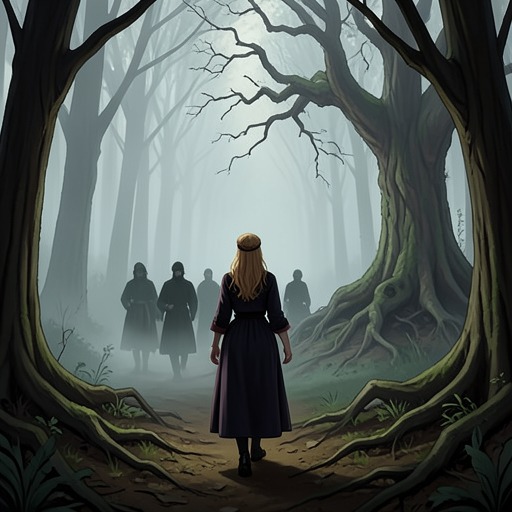
Smarighad is remembered first through its forests. Sylvaine recalls running there as a child, leaping over moss-covered roots without stopping for breath, among trees that rose beyond the eye and giant oyster mushrooms wider than a house roof, large enough to climb. These images give the homeland a scale that is almost magical, but the memory is not merely decorative. The forest represents a time when the natural world was trusted, play was possible, and Sylvaine’s body moved freely through a familiar landscape. Later, when she struggles to endure physical training, the memory of that former ease becomes a measure of how far exile has carried her from her first life.
The household in Smarighad also provided Sylvaine with an unusual cultural education. Her father required her to practice alphabets in the dirt before allowing her to play in the forest. She learned Ancient Elvish, Dwarvish, Common Tongue, and forgotten human languages, and she loved the access to additional stories that literacy created. This upbringing becomes crucial when she studies the dragon map: its directions combine old Common Tongue, dwarven runes, and Ancient Elvish, a language regarded as dead even in Smarighad. Her knowledge therefore links the homeland’s vanished linguistic culture to the expedition’s practical needs, turning a childhood discipline into a form of authority in the present.
The Homeland Before Exile
Sylvaine’s memories describe Smarighad as a community rather than merely a landscape. Friends, neighbors, and familiar people disappeared one by one, without farewells or explanations, until a childhood world of trust gave way to hiding. The elven raids are identified as the cause of this rupture. What had seemed like a gradual thinning of community was part of a wider bloodbath, later remembered as The Great Loss, after which elves were pushed to the lowest rank of society and an uneasy peace settled across the land.
The persecution rested on accumulated stories about elven magic and danger. Humans attributed undesirable events to supposed elven powers, including accusations that an elf had used magic to manipulate someone into an unwanted sexual encounter or to deceive a buyer. These suspicions prepared the ground for the raids and made ordinary elven presence appear threatening. Smarighad’s destruction thus emerges not as an isolated military catastrophe but as the consequence of a social order that had converted rumor into justification for violence.
Law, Displacement, and Departure
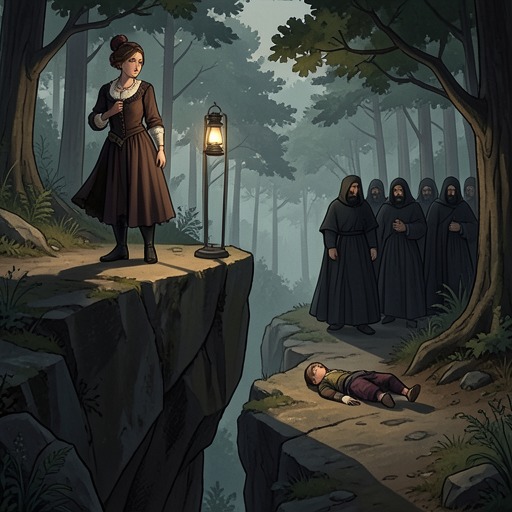
The raids were followed by legal dispossession. Elves lost the right to hold titles, including land. Those who refused to surrender property and move into cities, where searches and curfews governed their lives, were branded fugitives. Humans could pay a taxation fee for licenses to hunt fugitive elves for sport, and some hunters displayed elven ears on chains as trophies. The land remained bound to elven memory and generations of ancestors, yet its legal transformation made it impossible for Sylvaine’s people to experience it as home.
Escape was itself restricted by poverty and discrimination. Few vessels would transport elves to the continent, and Sylvaine’s family could afford only one boarding pass. She left her parents behind, knowing they faced imprisonment or something worse. Her passage out of Smarighad was therefore not a voluntary adventure or a clean break with childhood; it was an impossible family calculation in which her safety required separation. The homeland survives in her memory partly because departure prevented her from carrying her parents into the new life with her.
Smarighad’s Afterlife in Exile
After leaving Smarighad, Sylvaine stowed away on The Maiden’s Revenge and spent years moving through Bridgebarrow, Elmwood, Birchfield, and Hollowden before settling temporarily at the Rusty Nail. Her account of travel includes hunger, uncertainty, pickpocketing, and the need to make a living in local taverns. The contrast with her forest childhood is severe: the child who once climbed mushrooms and ran among ancient trees becomes a displaced performer who must cover her ears with a cap before every performance.
Yet exile also carries something forward from Smarighad. Sylvaine’s multilingual education allows her to read endangered or unfamiliar forms of writing, while her sensitivity to loss becomes part of her artistic vocation. She recalls discovering that vocation in Bridgebarrow, where a performer’s lute and voice transformed sorrow into music and then shifted effortlessly into a joyful tune. The encounter teaches Sylvaine that performance can hold contradictory emotions without erasing either one. Her art consequently becomes a way of carrying the emotional truth of displacement into public spaces, even when the audience does not know the language of the song.
The homeland’s history remains physically and psychologically present in her daily precautions. In places where anti-elf hatred is less open, Sylvaine can walk without expecting immediate attack, but she still checks that her cap covers her ears. The fear attached to Smarighad has traveled with her across the ocean. It resurfaces when a tavern patron seizes her and calls her a “knife-ear,” when groups of loud men make her wary of being alone, and when she hides in a tree rather than risk being seen in an isolated field. The danger is not confined to the former homeland; Smarighad has become the origin of a wider condition of vigilance.
Narrative and Thematic Significance
Smarighad gives Sylvaine’s story its central contrast between remembered belonging and enforced mobility. Its forests offer an image of freedom, but that freedom is interrupted by disappearance, raids, law, and exile. The place is therefore neither an uncomplicated paradise nor a backdrop for tragedy. It is a homeland whose beauty makes its destruction legible and whose social history explains why Sylvaine’s later resourcefulness is inseparable from fear.
The location also concentrates the novel’s treatment of language and cultural survival. Ancient Elvish has become a dead language, yet Sylvaine learned it in the household that formed her. When the language appears on the dragon map, the supposedly vanished culture speaks again through someone displaced from its land. Her literacy gives her access to stories, but it also preserves evidence of a world that persecution tried to make socially invisible. Smarighad consequently survives not through political restoration in the supplied narrative, but through memory, embodied knowledge, performance, and Sylvaine’s ability to read what others cannot.
Its deepest significance lies in the way home is separated from legal ownership. Elves’ ancestral ties to the land are explicitly acknowledged, even as law strips them of titles and converts their presence into a punishable offense. Sylvaine’s exile exposes the contradiction: a people may retain memory, language, and generations of attachment while being denied the right to remain. Smarighad remains home because it formed her, but it becomes lost because the surrounding order makes that belonging unsafe. Every later act of caution, resistance, storytelling, and connection carries the pressure of that unresolved loss.